Eva steadied her trembling hands as she stepped into Beelzebub’s throne room. Perry’s boots struck the obsidian floor beside her—slow, even.
He will die.
But he didn’t know. He couldn’t. He hadn’t seen what Megaera had shown her. Megaera only showed truth. That much she knew. But she didn’t know what that truth meant. You will walk alone. The words haunted her. Not yet. Not today, she pleaded.
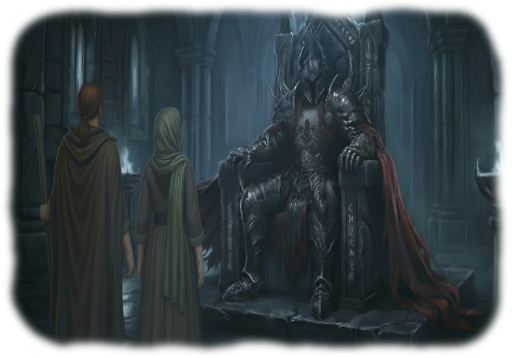
Her heartbeat pounded in her ears as they neared the throne. It was carved from dark stone, etched with glowing silver script. Lamps of pale flame flickered in the alcoves, casting an otherworldly glow across the chamber—like moonlight with no sky.
Perry stopped abruptly—just beyond the reach of the one seated on the throne. Dread Lord Beelzebub. Clad head to toe in black iron, spiked and etched with silver. The opening of the helm showed nothing. No eyes. No face. Just darkness.
Beelzebub didn’t move. He simply sat in silence, waiting. Watching. Eva could hear her own breathing, louder than she liked. Ragged.
Beelzebub rose. There was no creak of armor. Just silence, deafening in its weight. Perry stepped forward, placing himself between them.
“I am Peregrine Graycloak,” he said. “Guardian to Lady Evadne. Stand aside and let her pass.”
Beelzebub’s helm tipped slightly. “Guardian,” he said. The words dragged. “You?” He stepped down from the throne. Perry’s hand tightened on his staff. “Mud on your boots. Threadbare tunic clinging from the Slough. Staff in hand, as if that means something.” Another step down.
Perry raised a fist. “You should know better than to judge by appearances,” he said, voice calm, without a trace of anger. He opened his hand. The silver light caught the deep blue of the ring.
“I hold the authority to summon Michael and bring this castle down stone by stone. If a single hair on her head is harmed, nothing will remain standing.”
Eva tensed. He was telling the truth—but he’d added something. She recognized the mask. She’d seen it the first time they met. Like a child playing with his father’s weapon, unaware of its true power.
Beelzebub turned away from him and stepped toward her. Perry’s grip tightened on his staff. Her daggers called to her. No. Not yet.
Beelzebub reached into his armor, fingers closing around something unseen. She froze. Then forced herself upright, chin lifted the way she’d been trained.
And then— he knelt. The breath left her in a sharp gasp, the shock hitting harder than any blow ever could.
Beelzebub lifted his head, the void of his helmet fixed on her. Then he raised a hand. In his iron gauntlet, he held a silver necklace—delicate and cold as moonlight. A single blooming lily hung at its center, each petal etched with faint lines that shimmered like starlight caught in water.
“You won’t understand yet. But when the time comes, you’ll remember this moment. Summon, and I will come.”
Eva did not move at first. She stared at the Dread Lord, still kneeling before her. Her eyes caught the faintest etching of the same lily on his breastplate. She glanced at Perry. He nodded. Then she stepped forward and took it from Beelzebub’s outstretched hand.
Beelzebub remained kneeling until Eva stepped back. He said nothing more.
The Wicket Gate lay just ahead. Alecto led them back through the castle’s labyrinthine halls, returning to the place she had confronted them.
Eva ran her thumb over the silver lily in her palm, as if weighing what it had cost—and what it still might. Then she slipped it into the hidden pocket of her dress.
She turned to Perry. “Come, my dearest,” she whispered.

Commentary on Beelzebub
–
Dear Thoughtful—
I was delighted to read in your letter that Perry and Eva’s encounter with Beelzebub took you by surprise. That was exactly the effect I hoped to achieve. I did leave a hint, though—on page 159 of the bound copy of Tears of the Elect I sent you, with a fuller explanation on page 352.
This choice was not arbitrary. It’s deeply rooted in the mythology I’ve built for the Dream-Lands. This scene strikes at the very heart of who, or what, Beelzebub is supposed to represent in my stories.
The first clue lies in Eva’s trials at the hands of the Furies. I chose to portray Alecto not as the demonic force Bunyan describes, but to return to her roots in Greek mythology—as a pure force of justice.
Tisiphone’s trial represents the inescapability of guilt—where no excuse, cause or reason can absolve it. Alecto embodies the unforgiving weight of wounds inflicted by others. Megaera tests loyalty, no matter the cost. This should prompt the question: is Beelzebub truly evil? The answer is no.
The closest analogy—though not a perfect one—is Destruction from Neil Gaiman’s The Sandman. When you first introduced me to the series, I was struck by how closely its themes align with my own. I suspect Gaiman has read a fair amount of French philosophy, especially Michel Foucault.
Eva’s story takes place just before Christiana begins her journey with her sons—placing it around 1684. Destruction, from what I can tell, abandons his post around 1689, for the same reason Beelzebub does.
Michel Foucault identifies this period as the beginning of what he calls a new “episteme”—one that ushered in the Enlightenment, the French and American Revolutions, and the rise of modern thought, including democracy and capitalism. In this new order, the overt oppression of Beelzebub is replaced by subtler forms of coercion. Mammon.
Destruction recognizes this shift and chooses to step away, while Dream resists—and dies. In The Sandman, Dream embodies myth and narrative, which cannot survive the dissection of postmodern thought.
Tears of the Elect parallels this perfectly. It is the story of how I became disillusioned with the “old books”—the expectations and disappointments of the abandoned castle, the open gate, and the missing Cross. The ruined Interpreter’s House symbolizes the loss of meaning in life, and the crumbling House Beautiful represents the modern church. In other words, the death of the Dream.
But Gaiman, like me, doesn’t fall into the nihilism of postmodern thought. Instead, he moves forward into what some call post-postmodernism—or metamodernism. One of the key ideas in metamodern thought is “ironic sincerity,” popularized by writers such as David Foster Wallace. Hence, the rebirth of Dream. The return of meaning in the face of modern life. In my case, this is reflected in the Interpreter and Sophia in Vanity.
I’ve tried to write a layered story—though perhaps not very well. None of what I’ve explained should be necessary for the average reader to understand. Tears of the Elect can simply be read as the story of how I learned to be faithful to Beautiful and my family. And Redemption of Eva as a story about a love willing to descend into Hell and rise to the heights of Heaven. Perhaps it’s a modern retelling of Dante and Beatrice.
There is more mystery about Beelzebub that I haven’t revealed—though I’ve left several clues, both in this scene and in Tears of the Elect. I hope this eventual reveal is just as unexpected as this one was!
Sincerely,
Seeker